NOTES FROM THE WORKBENCH
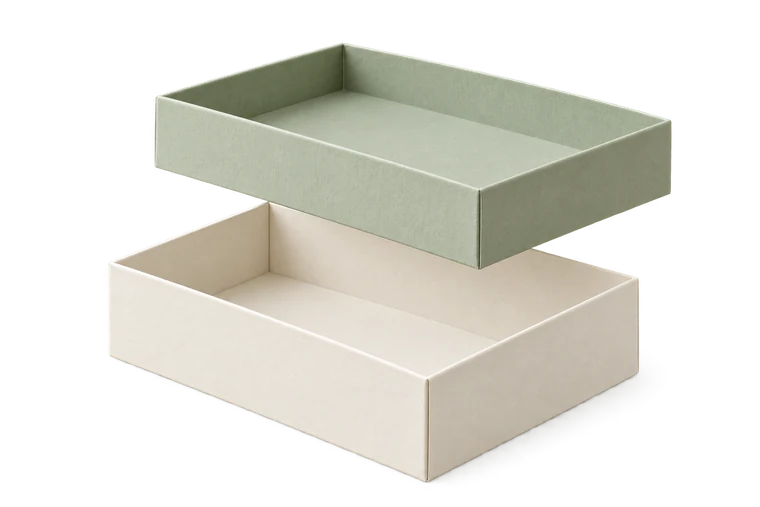
The same box in two different papers
Duplicate the project and change the material assumptions deliberately, keeping the object's measurements available for comparison.
Reviewed October 27, 2026
Preserve the version that worked
Before switching paper, save the current project and download a JSON backup. Duplicate it with a name that identifies the new stock. This keeps the old settings available if the second material behaves differently.
Retain the original object's measurements. A successful first box is not a reason to remeasure its outside and accidentally treat that as the new object's inside target.
Change the relevant inputs
If the structure uses thickness compensation, update that field with a measurement or reliable specification for the new stock. Do not infer thickness from GSM alone. For a two-piece box, review the per-side lid allowance separately rather than assuming it should equal the change in thickness.
For illustration, increasing the sheet thickness from 0.30 to 0.45 mm raises the simplified base outside estimate by 0.30 mm on each full axis, while the base inside target stays fixed. That calculation does not predict every real folded corner.
Expect a different folding response
The new paper may need a different scoring method, and its coating or grain can change how a tight fold appears. Try a small scrap before making the complete net. A heavier-looking paper is not automatically the better choice for a shallow fold or curved closure.
Print the calibration ruler again. If the new sample comes from another print application, a scaling change could otherwise be mistaken for a material effect.
Record what you actually observed
Assemble the second version and let the adhesive settle before comparing fit, opening and appearance. Write down the specific issue: lid tight on both axes, one corner raised, or sleeve catching at the seam.
Only change the setting connected to that observation. A controlled comparison leaves you with two meaningful projects and notes, instead of one overwritten file and a vague memory that the first paper was easier.
Sources and methods
Ready to make something?
Set the dimensions. Check the folds. Make a small test box.