NOTES FROM THE WORKBENCH
Card thickness and lid clearance
A lid needs room for the base walls as well as the clearance you choose. Here is one small, explicit estimate.
Reviewed October 27, 2026
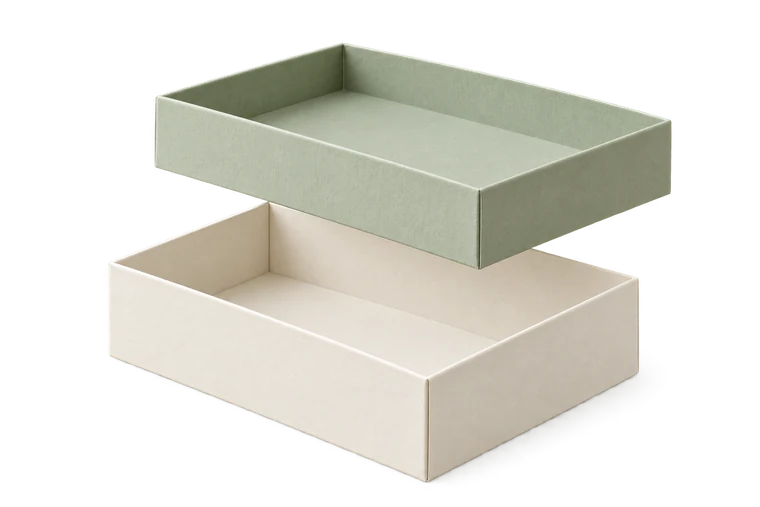
Three different measurements
Inside size describes the space you want for the object. Outside size includes the walls. A separate lid needs an inside opening that is larger than the base's outside size. Keeping these references separate makes the fit easier to adjust.
Paper thickness is not the same as paper weight. A GSM value tells you the mass of a square metre, not the caliper of the sheet. Use a measured thickness or a reliable specification for your particular stock. The 0.30 mm below is an illustrative input, not a default for every cardstock.
A small worked example
Suppose the base needs a 100 × 70 mm inside footprint. For this simplified model, add two sheet thicknesses to estimate its outside footprint. Then add the chosen clearance on both sides to obtain the lid opening.
With 0.30 mm stock and 0.50 mm clearance per side, the estimated base outside is 100.6 × 70.6 mm. The target lid opening becomes 101.6 × 71.6 mm.
| Measurement | Length | Width |
|---|---|---|
| Base inside target | 100 mm | 70 mm |
| Estimated base outside | 100.6 mm | 70.6 mm |
| Target lid opening | 101.6 mm | 71.6 mm |
What this estimate leaves out
This is a first-order estimate with ideal folds. Real paper bends over a radius, and scoring can compress it. Glue layers, grain direction, coatings and small cutting differences also affect the result. The figures describe the model's assumptions; they do not guarantee a finished fit.
Changing the lid allowance should change the lid, not the original base measurements. Keep the base fixed while you test a different clearance. Moving from 0.50 to 0.80 mm per side adds 0.60 mm to the lid's length and width.
Try the fit before the final cut
Print and check the calibration ruler before cutting. Make a small test fold with the same material you plan to use. Let glued corners settle, then lower the lid gently without forcing it.
If the fit is tight, first confirm the print scale and the thickness input. Adjust the lid allowance only after those checks. Save the revised project under a clear name so the original settings remain easy to recover.
Sources and methods
Ready to make something?
Set the dimensions. Check the folds. Make a small test box.