Guide
Inside dimensions and outside dimensions
Choose the measurement reference that answers the question you are trying to solve.
Reviewed October 27, 2026
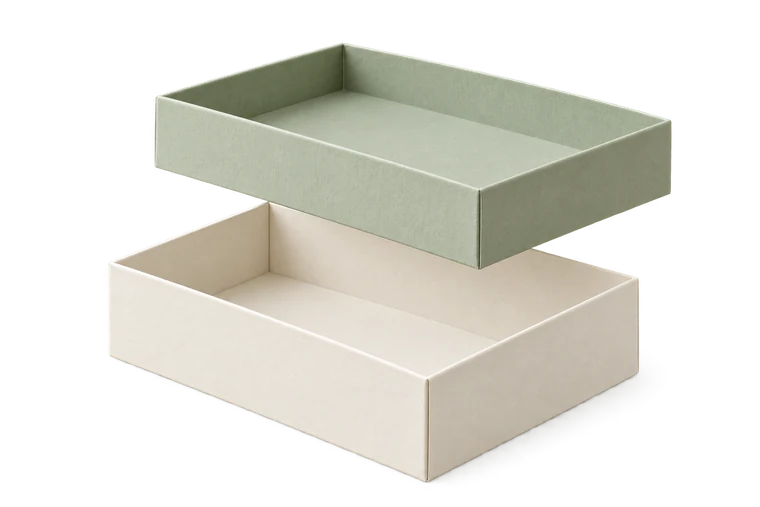
Three useful boundaries
Inside dimensions describe the clear space intended for the object. Outside dimensions describe the full finished footprint, including walls. Fold-line dimensions describe distances between creases in the flat material. They coincide only in an idealised zero-thickness model.
Use inside measurements for fitting contents, outside measurements for arranging packages in a drawer, and fold-line measurements when following a net's geometric construction. Check which one your chosen generator actually accepts.
Follow a lid calculation
For the two-piece example, a 100 × 70 mm inside base with 0.30 mm stock has estimated outside dimensions of 100.6 × 70.6 mm. Adding 0.50 mm per side produces a lid opening of 101.6 × 71.6 mm. The lid's fold-line footprint is a further sheet thickness larger.
These additions belong to a stated simplified model. They are not a general rule for every folded carton. Layers of glue, scoring compression and bend radius can change practical measurements.
Transfer a size carefully
When comparing a tray with a tuck box, do not assume that matching displayed numbers means equal usable room. Read the dimension-mode note, draw the relevant boundary and preserve the original object measurement.
After making a trial, record both the input and the measured result. This lets you adjust a project without gradually forgetting whether a number refers to the contents, a crease or the outside of the finished piece.
Sources and methods
Ready to make something?
Set the dimensions. Check the folds. Make a small test box.